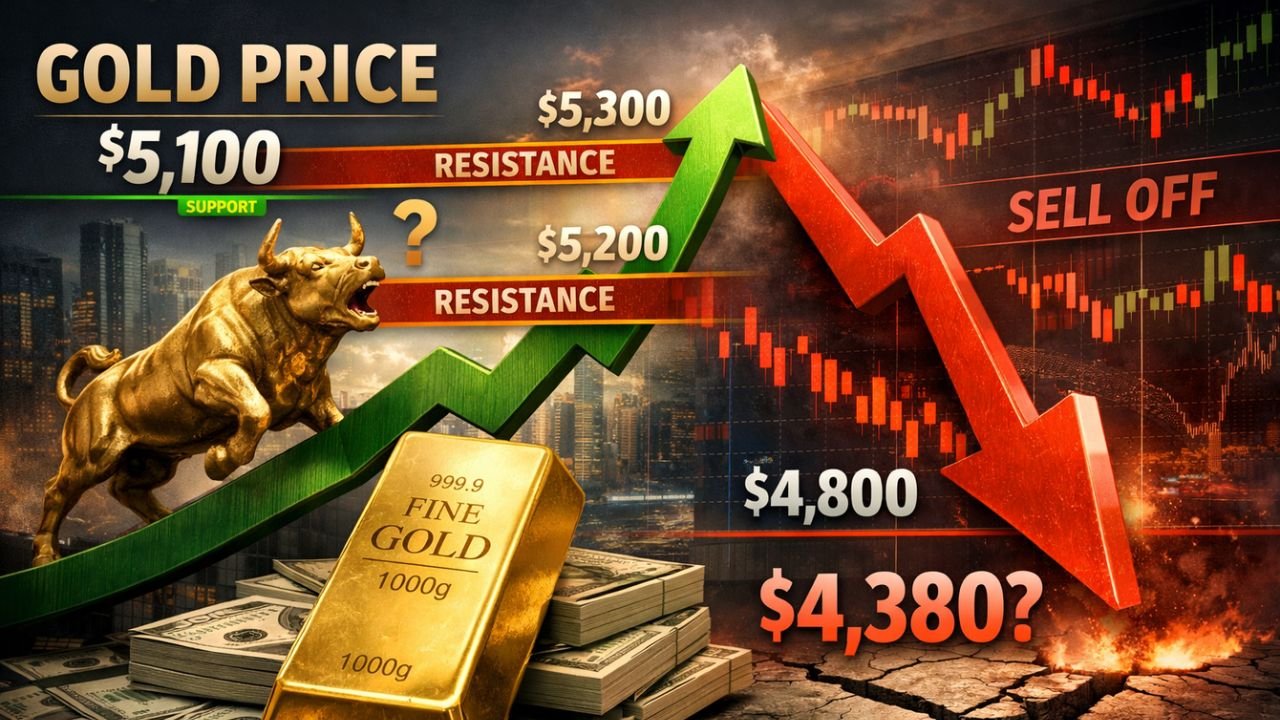
Gold prices are navigating a decisive juncture as the yellow metal hovers just above the $5,100 February breakout level, with resistance looming between $5,200 and $5,300 per ounce. According to Razan Hilal, market analyst at Forex.com, this is a pivotal moment for gold bulls, as momentum exhaustion could trigger a sharp retracement toward $4,380 per ounce if the breakout fails to hold.
Technical Landscape: Bullish Yet Vulnerable
After February volatility, gold has re-entered bullish technical territory, driven in part by renewed safe-haven demand amid global trade uncertainties and geopolitical tensions. Hilal highlighted that the move above $5,100 has reinforced investor conviction in precious metals, signaling a structural breakout that mirrors the conditions preceding the January selloff.

“Gold’s current strength is colliding with historically stretched momentum readings, raising questions about sustainability,” Hilal noted. “The setup presents a decisive inflection point where upside continuation and structural pullback risk coexist.”
The Relative Strength Index (RSI) is once again hovering near overbought levels, reminiscent of the price peaks seen in January before the sharp correction. This suggests that while bullish sentiment remains strong, the market is increasingly vulnerable to a rapid retracement if buying pressure falters.
Key Resistance Levels and Momentum Risk
The immediate focus for gold bulls is to decisively breach resistance around $5,200–$5,300 per ounce. Hilal stressed that these levels are critical for maintaining momentum, as the current technical profile indicates that stretched positioning could make the yellow metal susceptible to sharp corrective moves.

“Unless buyers can defend and push through the $5,200–$5,300 zone, we could see a momentum-driven reversal,” she explained. “The longer gold struggles near these levels without a decisive breakthrough, the greater the risk that sellers regain control.”
Support Zones and Potential Downside
On the downside, clear support levels outline the structural path lower if gold fails to hold the $5,100 breakout. A close back below this barrier could reignite consolidation risks, initially targeting $4,800, with subsequent support at $4,600, $4,530, and ultimately $4,380 per ounce.
“Gold’s trajectory now depends not only on macro-driven safe haven flows, but also on the market’s ability to sustain the breakout zone before momentum shifts back to sellers,” Hilal said. These support levels previously acted as demand clusters, suggesting that retracements may attract renewed buying interest, though timing and strength remain uncertain.
Recent Market Activity

Gold briefly surpassed the $5,200 mark early Wednesday, reaching a session high of $5,217.78 before pulling back toward support, illustrating the tug-of-war between buyers and sellers at these critical levels. Spot gold last traded at $5,207.02, marking a 1.23% gain on the daily chart, signaling that investors remain cautiously optimistic even as technical pressures mount.
This pattern highlights the delicate balance between bullish momentum and the risk of rapid corrections, emphasizing the importance of intraday trading behavior in shaping the broader trend.
Drivers Behind the Gold Rally
Several macro factors continue to underpin gold’s bullish case:
- Safe-Haven Demand: Heightened trade policy uncertainty and geopolitical tensions are driving investors toward gold as a secure store of value.
- Inflation and Monetary Policy: Persistent inflationary pressures and accommodative monetary policies have reinforced the yellow metal’s appeal amid a challenging macroeconomic environment.
- Structural Market Trends: Central bank buying and limited physical supply are sustaining upward pressure, providing a backdrop for continued strength despite technical overextension.
Hilal cautioned, however, that technical resistance and stretched momentum could temporarily cap gains if bullish flows do not continue.
Strategic Implications for Investors
For investors navigating this volatile landscape, Hilal recommends a balanced approach that considers both technical levels and macro drivers:
- Monitor Resistance Levels: Breach of $5,200–$5,300 is crucial for continuation of the rally. Failure to clear these zones may trigger corrective selling.
- Watch Support Zones: Investors should track $5,100, $4,800, and $4,380 for potential buying opportunities or risk mitigation strategies.
- Balance Long-Term and Tactical Positions: While gold remains an attractive hedge against inflation and geopolitical risk, short-term technical dynamics require vigilance to avoid momentum-driven losses.
Conclusion: A Decisive Crossroads
Gold is at a pivotal moment, balancing between bullish continuation and the risk of a sharp retracement. The next moves above $5,200 and $5,300 will likely define the medium-term trajectory, while failure to sustain momentum could see prices testing key support levels down to $4,380 per ounce.
As market participants weigh technical conditions against macroeconomic drivers, gold’s path will hinge on the interplay of investor sentiment, safe-haven flows, and momentum dynamics. For now, the yellow metal remains a central focus for those seeking both opportunity and protection in a volatile financial environment.