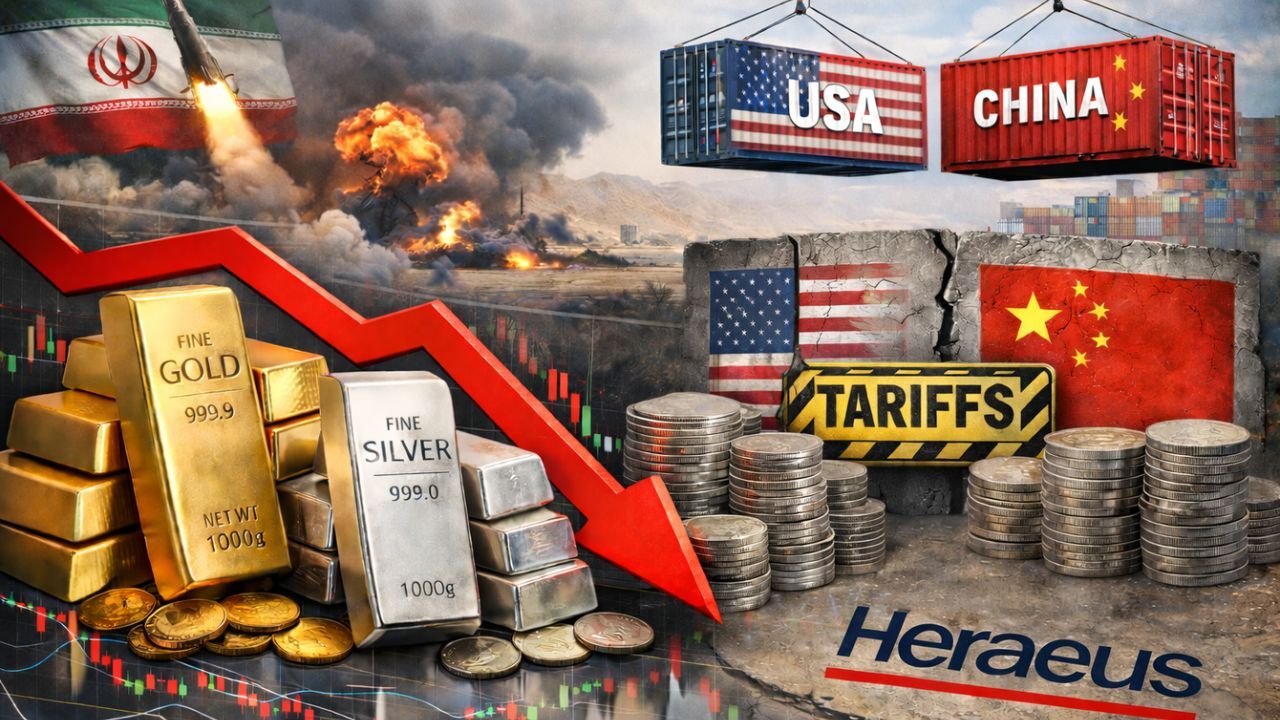
Gold and silver prices are showing signs of continued weakness, with analysts at Heraeus cautioning that both metals may have further to fall before establishing a firm price floor. Despite supportive factors such as the ongoing Iran conflict and lingering trade uncertainty, market dynamics suggest that precious metals remain in a correction phase following extraordinary rallies over the past year.
Historical Price Patterns Signal Continued Pressure
Heraeus analysts highlighted that the dramatic price surges seen in late January have set the stage for extended retracements. Silver, which rose 72% in a single month and 322% since early 2025, and gold, which climbed 30% in January and 115% over the same period, have both retraced significant portions of these gains.

“After the recent peak, silver has retraced about 50% of its decline, while gold has retraced roughly 70%,” the analysts noted. They pointed to historical precedents, including rallies in 1980 and 2011, where silver prices approached $50 per ounce before enduring prolonged declines. Such patterns suggest that, even with supportive factors, metals may require months—or even years—to fully stabilize.
Geopolitical Risks Provide Short-Term Support
The ongoing Iran conflict continues to inject volatility into global markets. Heraeus reported that U.S. and Israeli missile strikes on Iran, coupled with retaliatory actions across the region, triggered immediate safe-haven buying. Gold initially surged more than 10% in February, reflecting both the geopolitical risk premium and prior market positioning.
“Safe-haven bids lifted gold and the U.S. dollar, with other precious metals following gold higher,” the analysts wrote. They noted that the U.S. military buildup in the region may have already priced in some risk, limiting the potential for additional upside until further developments unfold.
Trade Uncertainty Adds Complexity

Economic uncertainty has risen further following the U.S. Supreme Court’s ruling that President Trump lacked authority to implement most trade tariffs. Although Section 232 tariffs on auto imports remain, the administration has imposed new 10% tariffs under alternative legislation for a 150-day period, creating uncertainty for importers and investors.
“The new tariffs throw various trade agreements into doubt and alter costs for U.S. importers, adding to the volatility in metals markets,” Heraeus noted. These factors continue to support gold as a hedge against policy uncertainty, even as broader market corrections unfold.
Mining Sector Developments
On the supply side, major mining companies are adjusting production schedules. Heraeus highlighted Newmont’s planned decline in gold output by 0.6 million ounces to 5.3 million ounces in 2026, with growth expected to resume in 2027. Projects such as Ahafo North in Ghana, Boddington’s higher-grade ore access, and the Tanami Expansion 2 will underpin longer-term production targets.

Supply adjustments from major miners, combined with geopolitical and economic pressures, contribute to the complex backdrop for precious metals pricing.
ETF Flows Reflect Investor Sentiment
Investor behavior, particularly in exchange-traded funds (ETFs), provides additional insight into market trends. Global silver ETF holdings rose by over 18 million ounces last week, reflecting renewed investor interest following price rebounds. However, total silver ETF holdings remain below levels seen at the start of the year, signaling cautious accumulation.
Similarly, Heraeus analysts noted that Chinese exchanges have reduced margin requirements and daily price movement limits for silver and gold, improving liquidity but leaving room for further enhancements to encourage trading activity.
Current Market Levels and Outlook
Spot gold recently traded at $5,294.29 per ounce, posting modest gains, while spot silver traded at $87.66 per ounce, marking a 6.34% daily loss. The analysts emphasized that, although near-term factors such as the Iran conflict and trade uncertainty provide support, the broader correction phase is likely to continue until excessive optimism from prior rallies is fully unwound.
Silver, given its higher volatility, may experience sharper swings, while gold’s trajectory suggests a more gradual path to its price floor. Investors are advised to consider both metals within a diversified portfolio, balancing safe-haven demand with potential downside risk.
Strategic Implications for Investors
- Cautious Positioning: Both metals may continue to decline, suggesting a measured approach for new investments.
- Geopolitical Hedging: Ongoing conflict in the Middle East underlines the role of gold as a protective asset.
- ETF Accessibility: Exchange-traded funds provide a convenient and liquid means to participate in precious metals markets without physical storage concerns.
- Long-Term Perspective: Historical patterns indicate that recovery and stabilization can take months or even years, emphasizing patience and strategic allocation.
While gold and silver face further downside potential, supportive geopolitical and economic factors maintain their relevance as safe-haven assets. Investors should navigate the current volatility with a disciplined approach, using ETFs and diversified holdings to manage risk amid uncertain global conditions.